
Seacoast Housing Conversations Convenes Local Leaders on Innovative Economic Development Tools for Housing


On Tuesday, June 16, 2026, the Workforce Housing Coalition hosted our second session of Seacoast Housing Conversations at the McConnell Center in Dover. Organized in partnership with UNH Cooperative Extension, Seacoast Housing Conversations is a new program designed to bring knowledge sharing, networking, and regional community building to municipal leaders and housing professionals.
The first Seacoast Housing Conversations was held in March 2026 in Exeter, where representatives from partner organizations shared resources and participants discussed their own communities’ opportunities and challenges. Attendees of our inaugural event also provided feedback on future topics that they would like the group to discuss.
The topic for June’s event was Leveraging Economic Development and Innovative Financing Tools to Advance Housing Opportunity. The session introduced common financial tools associated with housing and economic development, and much of the time was spent discussing examples of projects across the Seacoast, their evolution over time, and the community benefit of these programs.
The two main economic development tools highlighted in this session were RSA 79-E, the Community Revitalization Tax Incentive Program, and Tax Increment Financing (TIF) Districts. Other tools mentioned included Opportunity Zones, Economic Revitalization Zones, Transfer of Development Rights, and historic preservation grants.

In short, RSA 79-E is a temporary tax incentive for a property owner who wants to substantially rehabilitate a building located in a historic district or downtown. In exchange for the added community benefit, qualifying developers receive tax relief for the increased property taxes that result from the higher value of a building after rehabilitation. The timeline of tax relief is determined by the municipality and can be extended depending on the project use and design (e.g., if it includes affordable housing units). For a more in-depth explanation, see this report from NH Housing.

A TIF district is created to fund public improvements with the incremental taxes created by new construction or expansion of property within an area of the community that has been designated through a voting process. In return, these municipal improvements allow for additional development in that corridor, which generates tax dollars. These tax dollars are used to pay the cost of the improvements directly. For more information on TIF districts, see this page on NH BEA’s website.
Using these tools requires community support, staff know-how, and developer cooperation. When done thoughtfully, the result is a greater public benefit than what could have been achieved had these innovative financing techniques not been leveraged.
Welcome Remarks: The Dover Example

After opening the event with welcoming remarks from UNH Extension’s Nate Bernitz and WHC’s Maeve Nolan, Dover’s Deputy City Manager Chris Parker spoke to highlight the host community. Over the last few decades, Dover has undergone a rapid transformation and serves as a regional hub for entertainment, arts, culture, dining, and community activity.
Parker, having worked for the City of Dover for over 25 years, has witnessed and influenced this evolution firsthand. The adoption of RSA 79-E and the passage of multiple TIF Districts allowed for redevelopment in commercial/residential corridors while signaling to developers that the City was open to partnership and committed to their own future.

These partnerships and projects have dramatically boosted housing supply in Dover. Though prices in Dover and region-wide are still on the rise, the use of these financing tools continues to address infrastructure, revenue, and affordability concerns.
It is clear from Dover’s example that economic and housing development are best achieved when they are considered simultaneously, and the leveraging of existing tools is crucial for the greatest community benefit.
Panel Discussion with the Experts: So, What’s This All About?

In addition to facilitating conversations with all attendees, a goal of these sessions is to bring in experts to discuss the chosen topic on a panel. We were joined by Mike Scala, Director of Economic Development for the City of Rochester; Bart McDonough, Director of Planning and Development for the Town of Newmarket; and Sarah Wrightsman, Manager of Community Engagement and Education at New Hampshire Housing.
Understanding that each community is at a different moment in their economic development journey, these panelists were selected to represent a larger city, smaller town, and statewide perspective, respectively. The questions for the panel, moderated by Nate Bernitz, ranged from specific use cases to messaging to sticking points.

In the City of Rochester, Scala noted, the adoption of 79-E has brought new life to the downtown area through mixed-use development in buildings that would have otherwise remained vacant and underutilized (like The Hoffman Building).
Other parts of the city have benefited tremendously from the improved infrastructure that arose from the implementation of a TIF district.
Still, misconceptions of the tools have made the city wary of doing too much too quickly. Scala was steadfast in his messaging: 79-E and other state-sanctioned development tools are not a blanket tax break to a private developer. In fact, Rochester’s 79-E projects with expired delays are now adding millions in property taxes to city revenue, on lots that had previously been undesirable and rundown.
Speaking with greater hindsight, Bart McDonough echoed Scala’s experiences with his own in Newmarket. The redevelopment of the mill buildings in Newmarket’s central corridor was a direct result of RSA 79-E, alongside TIF districts and federal grants for historic preservation and environmental hazard mitigation. It was the partnership of the developer and the town, through its embrace of this innovative tool, that allowed the mills to be transformed from dilapidated industrial buildings to a center of community.
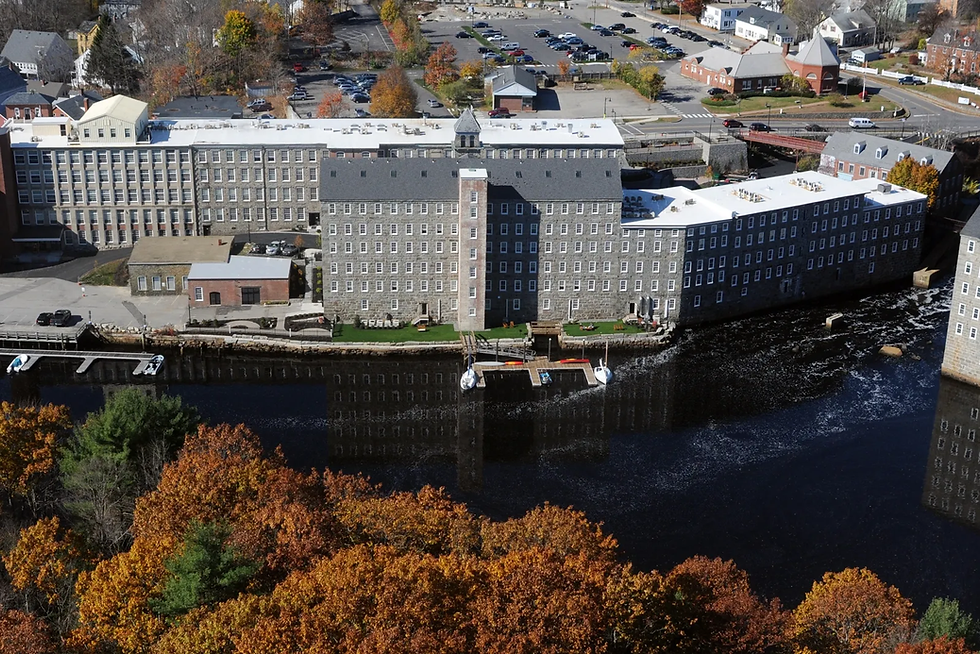
In addition to the housing units that were created through this adaptive reuse project, McDonough also spoke to the redevelopment at a greater scale. Increased walkability and connectivity to Downtown bolstered existing small businesses and inspired new commerce. The addition of the Millspace, a community civic and arts venue, reinforced the town’s cultural and historic presence in the region.
As McDonough put it, using these tools correctly requires long-term vision for what leaders and citizens want for their community. In Newmarket, these investments in economic development and housing opportunity have certainly paid off in the long run.
While Newmarket and Rochester have been utilizing these economic development strategies for years, it is important to remember that many towns are just now starting their journey, noted Sarah Wrightsman. New Hampshire Housing, a state-wide agency, provides technical assistance to municipalities that range from metropolitan to rural, with corresponding levels of community appetite and difficult constraints.
In smaller towns, which often lack the infrastructure for large commercial or residential development or the staff to oversee such projects, the ways to approach economic development tools are likely different than in larger municipalities. This, however, does not preclude them from innovating and iterating until the program works. The evolution of RSA 79-E, in particular, has widened the original goal of downtown revitalization to include options for office conversions, residential property revitalization, and economic opportunity zone designation. According to Wrightsman, this creates even more tools in the toolbox.
Though staff capacity, technical expertise, and infrastructure remain barriers to adoption for many communities, opportunity exists as well, with housing practitioners and professionals eager to help. It is for this reason that regional collaboration and peer-learning are crucial for all aspects of community development.
Community Breakout Groups: That’s Great, But How Can I Bring This Back Home?
After a brief Q&A section to wrap up the panel, participants turned to smaller breakout groups to discuss what they’d heard, and how they might approach these methods in their own communities. Breakout groups were pre-assigned to align municipalities of a similar size and infrastructure capacity, given that these constraints are often the main barriers to adopting economic development tools.
The breakout groups were guided by two questions:
In your community, what has been a success in using, or barrier to adopting, these economic development and innovative financing tools?
What is the biggest source of pushback when introducing these programs, and what messaging strategy would be most effective in addressing that narrative?
With a wide range of municipalities at different levels of current involvement with these tools, these questions sparked great discussions.

Representatives of larger cities like Rochester and Dover continued to express the merits of these programs for strengthening local businesses and adding housing units where infrastructure already exists or was expanded with a TIF. The Town of Derry has used state-sanctioned tools in conjunction with locally crafted programs for the arts to add cultural aspects to their economic development strategy.
Meanwhile, other communities are actively exploring how the tools could work for them. Hampton recently adopted RSA 79-E for residential conversions of office space while Portsmouth is in current discussions about which 79-E uses would make sense for the city.
Some attendees from smaller towns spoke on balancing rural character and environmental sensitivities with the need for economic growth in the face of demographic shifts.
Takeaways: What Can I Do, and What Can We Accomplish Together?
The breakout group conversations and panel discussion both emphasized a key aspect of these economic development tools: flexibility is crucial for implementation. With the expansion of RSA 79-E, lawmakers are recognizing that not all municipalities can make one program work, but they can all benefit from the result.
It was also clear that messaging and skepticism around these programs remains a central barrier to adoption and implementation across the region. The tools are often viewed as uneven tax breaks to private developers from which the town will never benefit. As both Scala and McDonough noted, effective use of these programs requires steadfast visioning and technically nuanced communication with residents, business owners, and stakeholders.
It is for these reasons that the WHC, UNH Extension, and our partners are committed to carrying on regional facilitated conversations for the Seacoast’s housing leaders and municipal officials. Though each community has been shaped by differing history, demography, and capacity, systemic issues like economic development and housing opportunity must be discussed at all levels.
Seacoast Housing Conversations aims to bridge the gap between the hyper-local and the regional to influence community-level and state-wide implementation of policy and strategic tools.
WHC extends a thank you to Chris Parker, the City of Dover, and the McConnell Center for hosting our June session. We would also like to thank our panelists and facilitators for lending their time and expertise. And finally, we thank the attendees from across the Greater Seacoast region for their engagement and thoughtfulness.
Stay tuned for our next Seacoast Housing Conversations event in the fall! If you have a topic idea, questions, suggestions, or would like to know more about the program, please reach out to Maeve Nolan at coordinator@seacoastwhc.org.


Comments